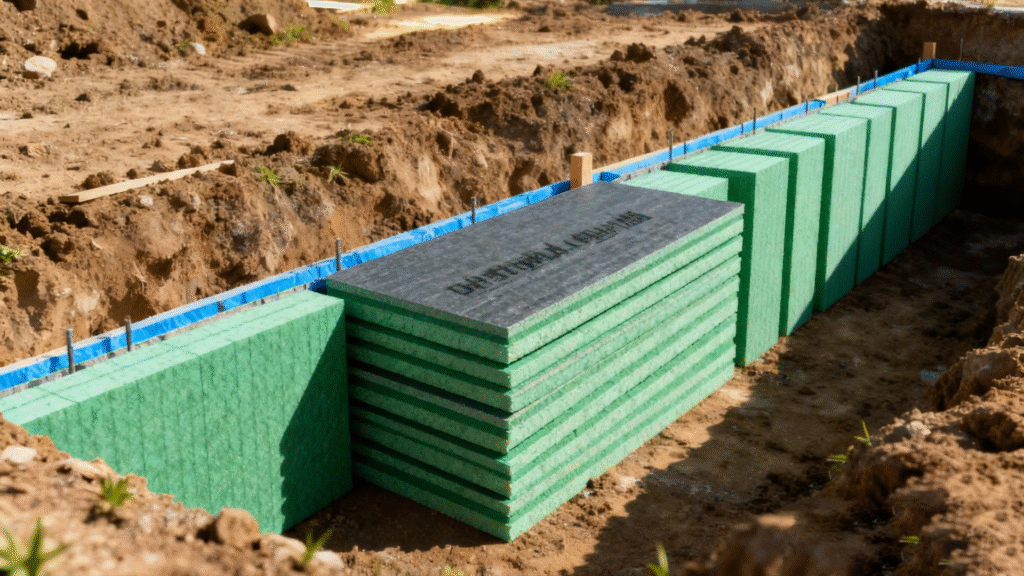
Foundation insulation is one of those decisions that doesn’t show its impact on day one. The wall gets backfilled, the site moves on, and the building only “reviews” that choice later—when a basement feels colder than expected, when condensation shows up along slab edges, or when energy use doesn’t match the model. At that point, the materials are buried and access is the expensive part.
That’s why comparing XPS and EPS for below-grade work shouldn’t start with label R-values alone. Real durability comes down to what the foam will face underground: long periods of damp soil, steady pressure from backfill, freeze–thaw cycles in cold regions, and the reality that installation isn’t always gentle. This article breaks the choice into practical checkpoints—site moisture risk, strength requirements, and how to specify by grade—so the insulation selected on paper is the insulation that performs years after the job is closed.
Match the board to the site risk
Durability below grade is mostly a “site conditions” decision, not a brand-preference decision. If the foundation is likely to stay damp for long stretches—high water table, slow-draining clay, heavy rainfall, poor grading, or unknown backfill quality—XPS is usually the safer choice because it tends to hold its performance more steadily when moisture is part of the reality. On the other hand, when drainage is designed correctly and built correctly, EPS can deliver excellent long-term results and is often the better value per project, especially on large foundation footprints.
On real jobs, the cost difference between XPS and EPS is rarely the main issue. The main issue is what happens after the wall is buried: insulation that slowly loses effectiveness can show up as cold basement walls, condensation, musty smells, or uncomfortable floor edges—even when the heating system is fine. The smarter approach is to treat insulation selection as risk control: higher moisture risk usually justifies the extra margin of XPS, while controlled moisture conditions can justify EPS with the right grade.
What “durability” means below grade
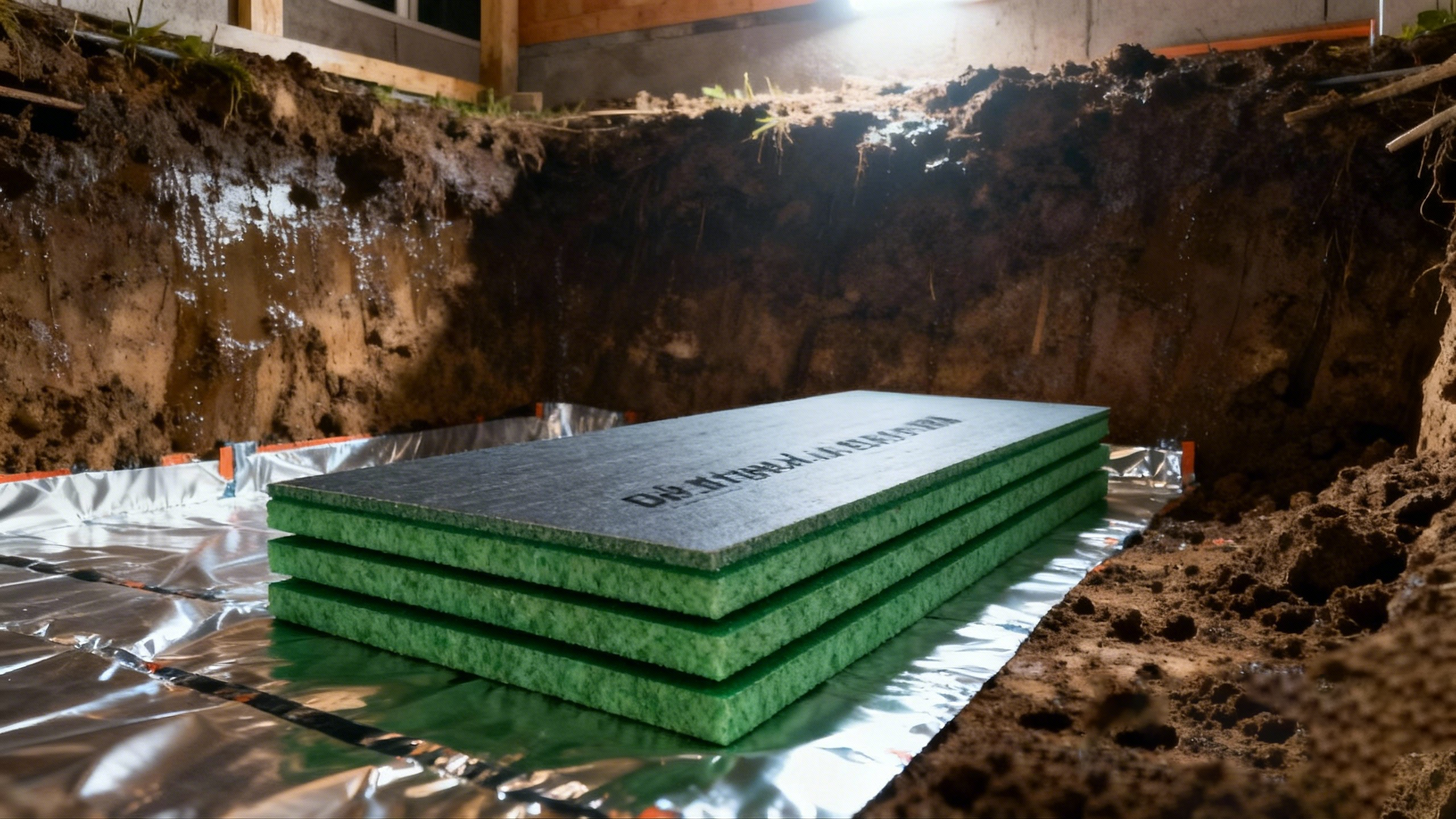
Foundation insulation durability means the board keeps doing three things for years: staying insulating, staying in shape, and staying intact enough that the system works as designed. Below grade, the insulation isn’t living in a clean, dry cavity. It’s in contact with soil that can stay wet, it’s squeezed by backfill pressure and long-term settlement, and it gets scraped or nicked during installation. In cold climates, the repeated freeze–thaw cycle adds another layer of stress because moisture and temperature swings work together to create movement and performance changes.
Experience on site tends to show the same pattern: failures don’t happen because “foam is foam.” Failures happen because the assembly didn’t control water, the board wasn’t strong enough for the load, or the insulation got damaged during backfill and nobody noticed. Once it’s buried, fixing mistakes is expensive: excavation, landscaping removal, restoring drainage layers, and often reworking waterproofing. That’s why foundation durability is less about theoretical lab performance and more about what survives real construction and real soil conditions.
The biggest factor in long-term R-value
Moisture is the number one durability driver because it directly affects thermal performance. A foundation wall can look perfect from the inside and still lose efficiency if the insulation layer outside is frequently damp. In practical terms, XPS is commonly chosen in wet foundations because it generally resists water uptake better and stays more consistent when exposed to persistent moisture. That consistency is what owners feel as stable comfort and predictable energy use over time.
EPS can also be a durable below-grade option when the foundation detail keeps water moving away from the wall. That means waterproofing that’s installed cleanly, a working drainage path, free-draining backfill, and protection so the system isn’t punctured during backfill. With EPS, grade selection matters more because performance is closely tied to density and intended use; the “cheap EPS” that works fine in packaging or above-grade applications is not the same as EPS specified for foundation loads and wet soil exposure. When EPS is correctly specified and the water-management details are treated as non-negotiable, it can perform for the long haul and often delivers a better cost balance on large projects.
Don’t buy by name, buy by grade
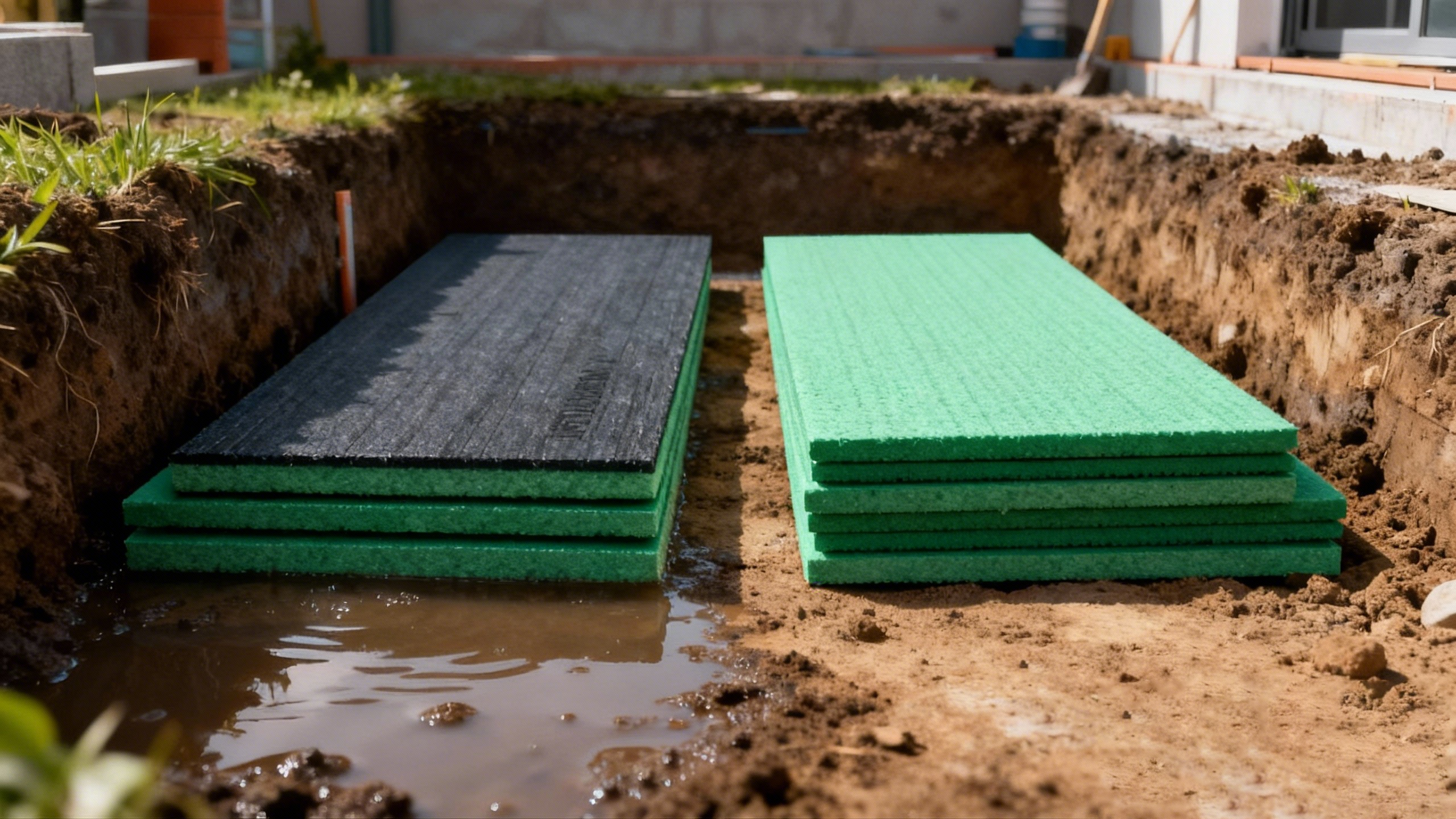
A lot of foundation insulation problems are mechanical, not thermal. Boards get pressed by soil, impacted by rocks in backfill, and stressed around corners, ledges, and transitions. If compressive strength is underspecified, you can see crushed edges, boards that don’t stay tight at seams, or gradual thickness loss in higher-pressure zones. Even small gaps become thermal bridges, and once cold spots form, condensation risk rises at predictable locations like slab edges and lower wall sections.
This is where procurement needs to be specific. EPS comes in multiple grades (often correlated with density), and those grades behave very differently under load. XPS also comes in different strength levels, and “whatever is in stock” is not a proper foundation spec. A durable foundation order calls out the required compressive strength, thickness, dimensional tolerances, and intended application. It also considers edge profile and fit-up, because boards that install square and tight reduce air and moisture pathways, reduce heat loss at seams, and protect the continuity of the waterproofing and drainage layers.
What experts and standards emphasize
Professionals who work on building envelopes tend to agree on one thing: below grade, insulation durability depends on verified properties and water management, not marketing claims. That’s why serious projects rely on recognized standards and documentation rather than product slogans. In North America, rigid cellular polystyrene insulation is commonly specified using ASTM C578, which provides a structured way to identify types/grades and physical properties. In Europe, common references include EN 13163 (EPS) and EN 13164 (XPS), which help align expectations for declared performance and product categories.
Standards matter because they make purchasing comparable and inspection easier. When an inspector, designer, or GC asks “what exactly is this board,” a credible answer includes compliance, strength class, intended use, and consistent datasheets—not just a label. It also reduces substitution risk: if a product is swapped, the replacement can be checked against the same standard requirements. This is an important part of durability because many “durability failures” begin as paperwork failures—wrong grade delivered, wrong board installed, and the problem only appears years later when the building is occupied.
Trustworthy manufacturing and who should work with a manufacturer
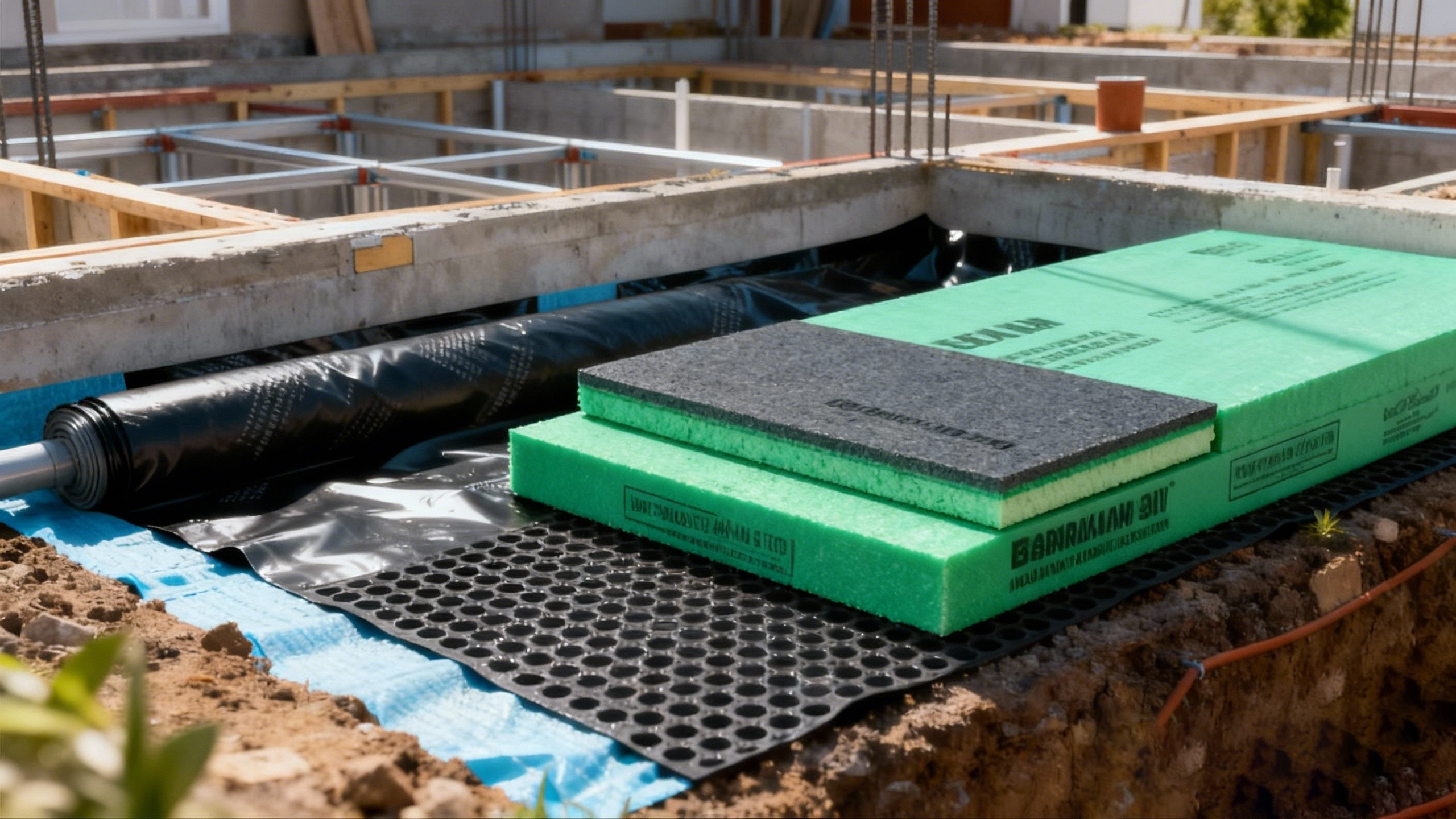
Foundation insulation is a hidden component that can’t be “maintained” once buried, so trust is built on consistency. A professional manufacturer brings repeatable production, stable dimensions, controlled density/strength, and traceable batches. That shows up in the field as boards that fit cleanly, hold up during handling, and match the submittals and approvals. It also shows up later when there are questions: traceability and documentation make it possible to confirm what was supplied and why it was appropriate for the application.
The best-fit customers for direct manufacturer cooperation are distributors who need steady supply and fewer jobsite complaints, contractors who care about install speed and board durability during backfill, waterproofing/foundation specialists who need compatibility with membranes and drainage boards, and developers/builders running multiple sites where standardization prevents costly variations. The value is practical: fewer callbacks, fewer disputes about what was installed, smoother approvals, and a foundation envelope that keeps performing long after the job is closed out. When the insulation is specified correctly, manufactured consistently, and installed as part of a complete water-managed system, durability becomes predictable rather than hopeful.
Below-grade insulation is a high-consequence purchase because it becomes inaccessible once the foundation is backfilled. If performance drops later, the real cost is not the foam board—it’s excavation, waterproofing repairs, schedule disruption, and the argument over responsibility. For procurement, the most reliable way to control that risk is to match the insulation type and grade to the site’s moisture exposure and loading conditions.
XPS is often chosen for wet or unpredictable foundations because it tends to maintain more stable performance when moisture is present. EPS can be a durable, cost-effective option when the project has dependable drainage and waterproofing and the correct EPS grade is specified for the expected loads. The “wrong EPS” problem is usually a grade/specification problem, not an EPS problem.
Supplier capability matters as much as material choice. A dependable manufacturer should provide clear standard compliance (ASTM C578 or EN 13163/13164), documented compressive strength and tolerances, consistent production, and batch traceability so submittals match deliveries. That level of documentation and consistency is what keeps approvals smooth and long-term outcomes predictable.