Does XPS Insulation Board Warp Over Time
XPS insulation board has a closed-cell structure and high compressive strength, unlikely to warp if properly installed and stored.
What Does “Warping” Mean for XPS Boards
Definition: Warping means bowing/cupping/edge lifting that reduces board flatness and makes installation harder.
Common causes: heat/UV exposure, uneven substrate support, excessive load beyond the board grade, poor storage/stacking.
What XPS resists: moisture-related swelling is less common due to XPS’s closed-cell structure and low water absorption.
How to avoid it: choose the correct compressive strength grade, store flat and shaded, install on a level substrate, use foam-safe adhesives.
When Is XPS Most Likely to Warp
Direct sunlight / high heat exposure
Uneven or unstable substrates
Low-strength grade used in high-load areas
Concentrated point loads
Solvent-based adhesives/coatings incompatible with foam
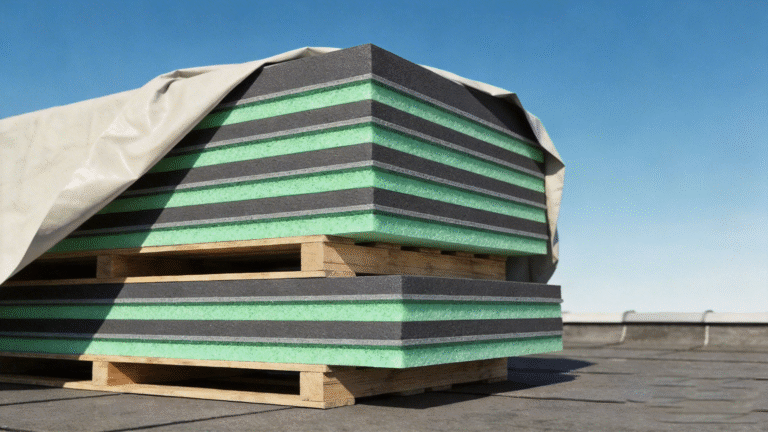
Improper stacking
Top Applications
Direct Sunlight / Heat Exposure
Why it matters: Prolonged heat and UV can soften XPS and lead to bowing, edge lift, or unevenness—especially when boards are not fully supported.
Recommended: Store flat on pallets, keep covered/shaded, minimize rooftop exposure time before covering with the next layer.
Notes: Avoid dark coverings that trap heat; inspect for persistent deformation before installation.
Uneven or Unstable Substrate
Why it matters: XPS follows the plane of what it sits on; high spots and voids create bending and “rocking,” which shows up as warping or lippage at seams.
Recommended: Clean and level the base; fill voids, remove protrusions, and use compatible leveling methods before placing boards.
Notes: Most “board warping” complaints are actually substrate flatness issues.
Overloading Beyond Compressive Strength Grade
Why it matters: If loads exceed the board’s compressive strength, XPS can take permanent deformation , presenting as dips or uneven planes.
Recommended: Select the correct compressive strength grade for design loads; verify with project specs and safety factors.
Notes: Overloading often appears after occupancy , not immediately at install.
Concentrated Point Loads
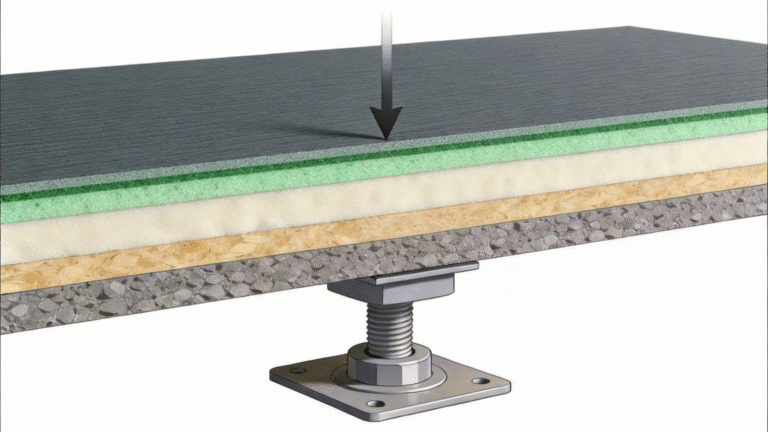
Why it matters: Point loads concentrate stress in small areas, causing localized crushing and edge distortion that looks like “warping” around joints.
Recommended: Use load-distribution layers and detail pedestals/feet with proper bearing plates.
Notes: Even a high-grade XPS can deform if the load is concentrated enough.
Incompatible Solvent-Based Adhesives / Coatings
Why it matters: Certain solvents can attack polystyrene, causing surface melting, shrinkage, or uneven thickness—leading to curling or loss of flatness.
Recommended: Use foam-safe adhesives/coatings and run a small patch test if uncertain.
Notes: Damage may start as pitting/softening before visible deformation occurs.
Choose Duolong with confidence
Duolong focuses on the manufacturing and supply of XPS (extruded polystyrene) insulation boards for construction projects, distributors, and export customers. With a closed-cell structure, XPS delivers low thermal conductivity, low water absorption, and strong compressive performance—making it a practical solution for areas that face moisture and long-term loads. Typical applications include inverted and flat roofs, underfloor heating systems, slab-on-grade floors, basement perimeter insulation, foundations, and cold storage facilities where stable insulation and condensation control matter.
At Duolong, we pay close attention to two things buyers care about most: batch consistency and on-time delivery. During production, we control key indicators such as thickness tolerance, density uniformity, and compressive strength, supported by routine inspection and record keeping. This helps contractors install with confidence and helps project owners reduce the risk of performance variation across different shipments.
To make procurement smoother, Duolong provides clear documentation aligned with B2B needs, including product datasheets, MSDS, and test reports when available. These materials support tendering, inspection, and customs clearance, saving time and preventing back-and-forth communication. We also support customization for different markets and channels, including board dimensions, colors, edge profiles (square edge, shiplap, tongue-and-groove), as well as OEM labeling and packaging.
From sampling to mass production, our workflow is straightforward: confirm one specification sheet, one packing standard, and one delivery schedule. We can also offer practical container loading suggestions to improve space utilization and reduce transit damage. Choosing Duolong means choosing stable quality, complete documentation, flexible customization, and dependable execution—so your projects and repeat orders are easier to manage.
FAQ Questions and Answers
Does XPS insulation board warp over time under normal conditions?
Generally no—proper grade, storage, and installation keep XPS stable.
Can sunlight cause XPS boards to warp?
Yes. Prolonged direct sun/heat can soften boards and lead to distortion.
Is warping mainly caused by moisture?
Usually not. XPS has low water absorption; heat/load/substrate issues are more common.
Why do boards look uneven after installation?
Uneven substrate or point loads are the most common causes.
Can XPS deform under concrete slabs?
Yes if the compressive strength grade is too low or loads are concentrated.
Can adhesive damage or deform XPS?
Yes. Avoid solvent-based adhesives; use foam-safe products.
Does thicker XPS prevent warping?
Not by itself—support, temperature exposure, and correct grade matter more.
How should XPS be stored to avoid warping?
Store flat on pallets, fully supported, protected from sun and weather.
If boards arrive slightly bowed, are they defective?
Not necessarily. Check storage/transport conditions and tolerance requirements.
How do I specify XPS to reduce deformation risk?
Specify compressive grade, dimensional tolerances, batch traceability, and proper installation methods.